
- Under the leadership of OP Pohjola, Finnish banks and major telecom operators have introduced a new cooperation model that makes it possible to cut off traffic to scam websites within minutes, thanks to banks’ data collection and rapid information sharing.
- The swift blocking of scam websites can significantly reduce phishing and other types of banking fraud and thus improve customer protection.
- The new model strengthens cooperation between Finnish banks, telecom operators and authorities. However, to ensure effective fraud prevention, continuous development and the removal of legal obstacles are also needed.
Finnish banks and telecom operators have adopted a cooperation model that enables traffic to scam websites to be blocked in a matter of minutes instead of days, as was previously the case. The cooperation is orchestrated by OP Pohjola and involves the banks Nordea, S-Bank, Aktia and Savings Bank, the three major telecom operators Elisa, DNA and Telia, as well as the cybersecurity company F-Secure. When a member bank in the cooperation network detects a scam website, OP Pohjola receives a notification and forwards the information to the operators, who then block traffic to the website.
In a typical phishing scam, criminals send out messages designed to lure customers to fake websites that have been cloned to look like legitimate bank login pages. The fraudster may, for example, pose as an authority or healthcare representative and trick the victim into using their banking credentials to log in to a fake online service under the guise of authentication.
“The new operating model will significantly reduce banking fraud cases, because blocking traffic to a scam website is much faster than taking down the site itself. The cross-sector cooperation enables broader and more effective protection for customers. We already piloted the model last spring to excellent results”, says Kim Sirén, head of fraud management at OP Pohjola.
According to Sirén, the swift blocking of traffic to scam websites will make it considerably more difficult for criminals to run such websites and will also close the several-day window of opportunity they had to collect victims. It will also circumvent the problem where the scam website’s server host refuses to shut down the website despite well-reasoned requests. In the new model, traffic to the site is blocked instead.
“The majority of the victims of a scam fall prey within the first few days. Rapid response during this critical period can efficiently stop the number of victims from increasing. The faster we cut off traffic to the scam website, the fewer customers end up being defrauded”, Sirén explains.
Although banks are constantly developing new ways to combat fraud, the customer’s own responsibility and need to remain vigilant remain as important as ever.
“Criminals are skilled at adapting their methods and manipulating customers. Customers must remain cautious and use their good judgement in unexpected situations also in the future”, Sirén adds.
The work is not finished – technological progress plays into the hands of both defenders and fraudsters
Finance Finland’s Head of Security and Loss Prevention Niko Saxholm compliments the new cooperation network.
“Rapid response is critical in fraud prevention, because the early stages of a new scam are when the most damage occurs. The piloted model is a good example of how collaborative effort can help achieve substantial results, especially in a small country such as Finland”, Saxholm says.
Saxholm emphasises that there is still much work to be done. Combating fraud is an ongoing battle in which every move by banks and authorities is countered by criminals, and vice versa.
“The number of scam attempts is massive as artificial intelligence enables individual actors to send hundreds of thousands of messages in seconds. AI-assisted scams are also extremely sophisticated. On the other hand, AI also offers banks and authorities ground-breaking opportunities to detect and intervene with suspicious activities”, Saxholm reflects.
The closer cooperation of banks and operators leaves criminals less room for manoeuvre and limits their operational capabilities. According to Saxholm, removing certain obstacles in legislation would further improve the efficiency of this cooperation. Especially the legal barriers to information sharing between banks and between banks and authorities should be eliminated.
“Without downplaying the significance of the new model, which I consider a genuine leap forward, I want to remind everyone that there is still plenty of work to be done in fraud prevention. It’s a joint effort that must involve banks, authorities, telecom operators and legislators ‒ and of course ordinary citizens, whose awareness and alertness will remain key also in the future”, says Saxholm.
Still have questions?
|Contact our experts




Looking for more?
Other articles on the topic

Banks and operators crack down on scam sites – new anti-fraud model enables faster response times
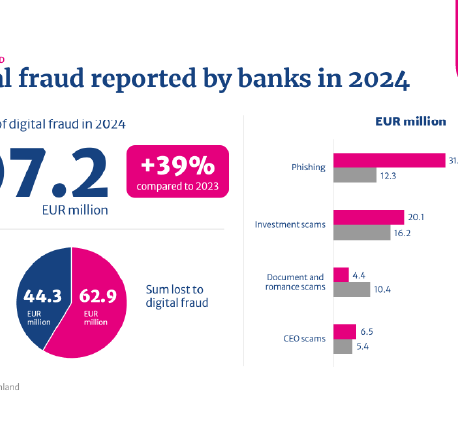
Volume of digital fraud skyrockets in Finland – Banks blocked more than €44 million’s worth of fraud-related payments in 2024

Investment scams increased by 90% in one year – Don’t buy a pig in a poke
Most Finns have experienced fraud – Finance Finland launches anti-fraud campaign