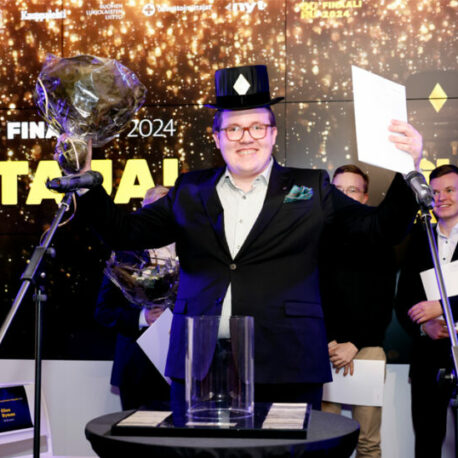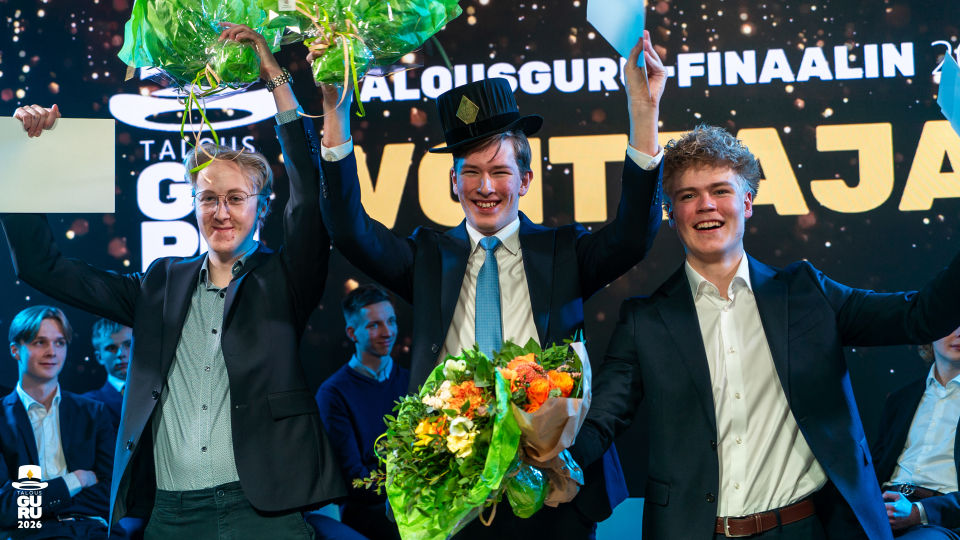
- The Economic Guru competition for general upper secondary school students was won by Marcus Anttila from Helsingin suomalainen yhteiskoulu (SYK).
- Second place went to Ossi Vatén from Lahden yhteiskoulu (LYK).
- Third place was taken by Aaro Heikkilä from Mäkelänrinne Upper Secondary School. He was also recognised as the best debater in the pair debate.
The Economic Guru is a Finnish economics competition for general upper secondary school students, in which the main draw is the chance to win a direct student place in one of eight Finnish universities. The competition has two parts: a preliminary round that all general upper secondary schools can organise for their students and a final for the finalists selected by the competition jury. The preliminary competition is a written test held simultaneously in early January at all participating schools, similarly to the matriculation examinations. This year, the competition was hosted at 116 general upper secondary schools, drawing nearly 1,100 students in total.
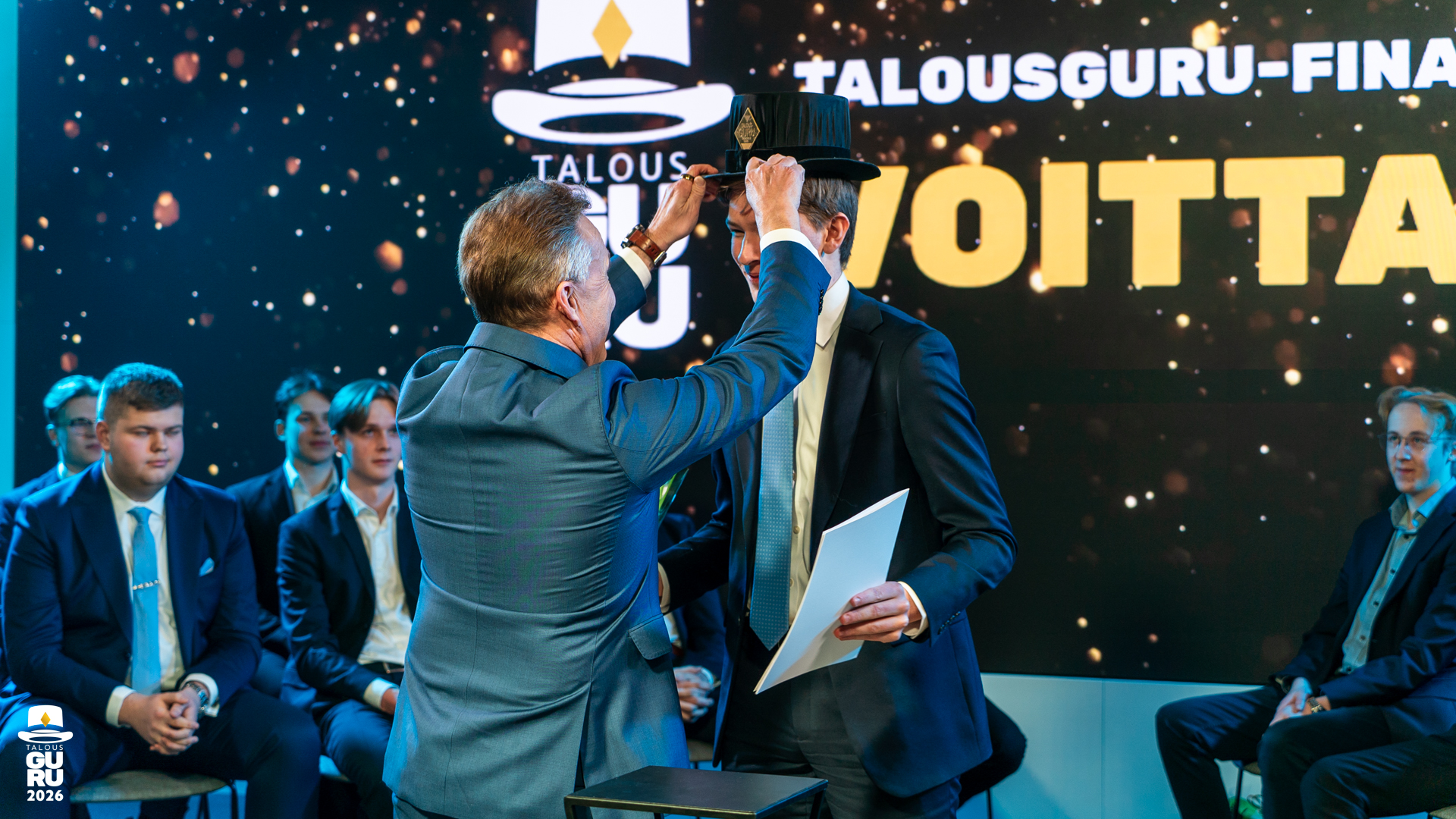
The Economic Guru competition that tests Finnish general upper secondary school students’ economics skills was held for the 28th time this year. The winner, Marcus Anttila, was crowned with the iconic doctoral hat that is passed from one winner to the next. The hat will take pride of place at the Helsingin suomalainen yhteiskoulu (SYK).
The winner was selected from among 13 finalists based on the combined results of a written exam and a debate. The debates were held in pairs and were broadcast live by the Kauppalehti business newspaper.
“Winning feels absolutely amazing. I put a lot of effort into preparing, so bringing the hat back to my school means a great deal. We’ve reached the top three in the previous two years, but it has been quite some time since we last won”, Anttila said after receiving the Economic Guru hat. Last year the hat resided at the Tampere Classical Upper Secondary School.
This year’s written exam required the finalists to analyse how the tariffs imposed by Donald Trump impact the United States. The written exam accounted for 75 per cent of the total score.
In the debates ‒ which accounted for 25 per cent of the total score ‒ the contestants were paired off to argue either for or against a given motion. The participants were assigned their position at random, regardless of their own views on the topic. To do well in the competition, the participants were therefore required to have solid argumentation skills in addition to economic knowledge. This year’s winner defended a motion stating that data centres are not beneficial for Finland.
“I don’t personally agree with the motion, but it wasn’t hard to come up with arguments for it. And it looks like it went well! I actually found the written exam more difficult than the debate”, Anttila reflected.
OP Pohjola’s Timo Ritakallio encourages young women to participate
In the preliminary round held at upper secondary schools in January, the competitors were required, for example, to analyse a set of data tables to compare the economies of Finland and the Czech Republic and to evaluate the accuracy of claims presented on the data. The exam’s essay question concerned business subsidies.
The Economic Guru was crowned – or behatted – by the Chair of Finance Finland’s Board Timo Ritakallio, OP Pohjola’s President and Group CEO. Ritakallio emphasised the importance of financial literacy and expressed a wish for broader participation from young women.
“Economic skills and financial literacy matter in the everyday lives of all Finns. It’s inspiring to see such a talented group of finalists emerge year after year from among more than a thousand participants”, Ritakallio says.
“Young women are just as interested and skilled in economic matters. This is evident, for example, in their growing interest in investing. However, many still hesitate to enter competitions. We need parents, teachers and friends to actively encourage more women to take part”, he adds.
Student places available for finalists at eight universities
Economic Guru finalists in 2026
(listed in alphabetical order)
- Marcus Anttila, Helsingin suomalainen yhteiskoulu SYK
- Albert Haapalainen, Töölön yhteiskoulu
- Aaro Heikkilä, Mäkelänrinteen lukio
- Joona Hytönen, Ressun lukio
- Rasmus Inkinen, Otaniemen lukio
- Oskari Jalonen, Tampereen lyseon lukio
- Kasperi Lilja, Hankoniemen lukio
- Leevi Majonen, Haukiputaan lukio
- Viggo Nyström, Ålands lyceum
- Miko Ritola, Sammon keskuslukio
- Tapio Tiihonen, Etelä-Tapiolan lukio
- Ville Tuononen, Joensuun lyseon lukio
- Ossi Vatén, Lahden yhteiskoulun lukio
Economic Guru finalists have the chance to win a direct student place in one of eight Finnish universities – Aalto University, Hanken School of Economics, Tampere University, the University of Eastern Finland, the University of Helsinki, the University of Jyväskylä, the University of Turku and the University of Vaasa – and skip the usual admissions process in which admission is based either on prior academic record or an entrance examination. The universities can offer student places to all or some of the finalists depending on their success in the competition.
Economic Guru is organised by Finance Finland (FFI), the Association for Teachers of History and Social Studies (HYOL) and the Finnish Financial Ombudsman Bureau (FINE). The competition is sponsored by the Kauppalehti business newspaper, Junior Achievement (JA) Finland, the Union of Finnish Upper Secondary School Students and the Taloustoimittajat association for economic journalists.
Further information:
- Emilia Peikola, Events and Communications Specialist, Finance Finland, tel. +358 20 793 4239
- Elina Antila, Head of Communications, Finnish Financial Ombudsman Bureau FINE, tel. +358 405483838
- Kirsi Ruhanen, Executive Director, Association for Teachers of History and Social Studies HYOL, tel. +358 44 303 1789
- Marcus Anttila, Economic Guru of 2026, tel. +358 45 344 5851
Debate motions in the final
Cryptocurrencies are a good investment / Cryptocurrencies are not a good investment
Selling state-owned assets is a reasonable way to pay off government debt / Selling state-owned assets is not a reasonable way to pay off government debt
Artificial intelligence is beneficial for employment / Artificial intelligence is not beneficial for employment
Finland needs a debt brake / Finland does not need a debt brake
Data centres are beneficial for Finland / Data centres are not beneficial for Finland
Tuition fees in higher education are a good thing / Tuition fees in higher education are not a good thing
Wellbeing services counties need the right to levy taxes / Wellbeing services counties do not need the right to levy taxes
Essay question
US President Donald Trump has imposed tariffs on goods imported to the United States from other countries. According to President Trump, the tariffs generate significant income for the United States, encourage the relocation of production and jobs to the United States and help to improve the United States trade balance. Assess the impact of the tariffs on the United States and its trading partners. Are President Trump’s promises realistic?
Looking for more?
Other articles on the topic
Marcus Anttila is the 2026 Economic Guru of Finnish general upper secondary school students
“Mette is good at logical reasoning and Veera at mathematics” – Students from Anna Tapio school compete in the European Money Quiz finals in Brussels
The Finnish Finance Hero competition takes an international twist – Finance Finland to send winners to the European Money Quiz finals in Brussels
Lauri Nyhä is the Economic Guru of Finnish general upper secondary school students