
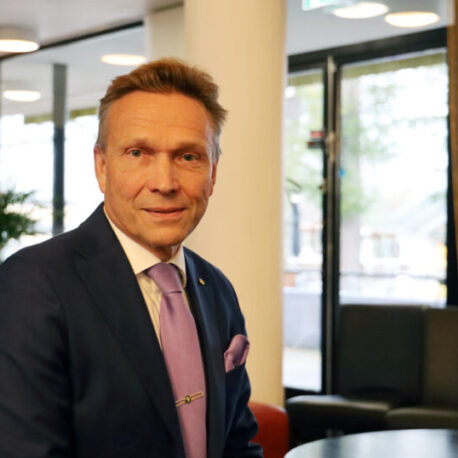
- OP Pohjola’s President and Group CEO Timo Ritakallio became the new Chair of Finance Finland’s Board of Directors at the start of 2026.
- According to Ritakallio, a comprehensive review of financial market regulation must be carried out without delay. Additional national regulation must be reduced to improve the availability and competitiveness of financing.
- Ritakallio emphasises that all regulation must ensure suitable conditions for strengthening growth and competitiveness.
OP Pohjola’s President and Group CEO Timo Ritakallio has assumed the role of Chair of Finance Finland’s Board of Directors for a two-year term starting January 2026.
Ritakallio’s term coincides with a significant political turning point: the first year will be marked by preparations for the parliamentary elections, and the second will see Finland’s new government begin its work. Ritakallio addresses his remarks to the current government, which is working to find solutions to weak economic growth.
“Although the elections are drawing closer, the current government should not delay the implementation of the comprehensive review of financial market regulation that was included in the government programme. This review must also lead to concrete measures during the next government’s term. It is essential to identify and dismantle national rules and practices that hinder access to finance and make Finnish regulation unreasonably stricter than in our peer countries”, Ritakallio urges.
Finance Finland’s Board of Directors 2026
Executive Chair:
Timo Ritakallio, President and Group Chief Executive Officer, OP Pohjola
Vice Chair:
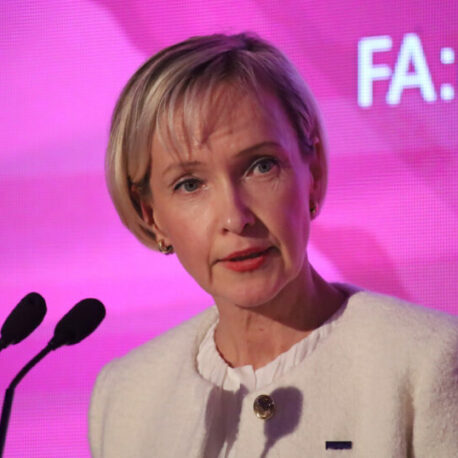
Sara Mella, Head of Personal Banking FI, Nordea Bank AB
Members of the Board:
Anssi Huhta, CEO, Aktia Bank
Jens Wiklund, Country Head of Finland, Head of Personal Banking Finland, Danske Bank
Hanna Hartikainen, CEO, Fennia
Mikko Mursula, CEO, Ilmarinen
Sari Heinonen, President, LocalTapiola Group
Petri Niemisvirta, Group CEO, Mandatum
Riikka Laine-Tolonen, CEO, S-Bank
Ville Talasmäki, Group CIO, Sampo Group
Kai Koskela, Managing Director, Savings Banks’ Union Coop
Risto Murto, President and CEO, Varma
The comprehensive review of financial market regulation should examine in particular how additional national regulation affects households, businesses and farmers in terms of their access to financing.
“Even though we’re approaching the end of this parliamentary term, and time is limited, the review must be conducted with thorough care. It is important to get a comprehensive, high-quality analysis of the problems in the current regulatory framework. This will enable the next government to continue the work to dismantle regulation that slows down the financing of growth”, Ritakallio explains.
Ritakallio notes that Europe has, as of late, begun to wake up to the problems created by expanding and increasingly complex financial regulation. Good examples of this are the European Banking Federation’s (EBF) ‘Less Is More’ report, which addresses regulatory issues, and the recently published recommendations of the high-level task force established by ECB’s Governing Council, which aim to simplify the regulation and supervision of European banks.
“The mandates of European and national financial supervisors should include growth and competitiveness objectives alongside stability and investor protection. Regulation should support economic growth as strongly as it safeguards stability”, Ritakallio argues.
“The financial sector could accelerate economic growth significantly if regulation permitted it.”
Overall, access to corporate financing in Finland is at a good level. However, the gaps that do exist in the availability of financing recently appear to have grown wider as the economic downturn has persisted.
“The large volume of banking regulation drafted after the financial crisis affects not only access to financing but also its terms and allocation. Regulation has an increasingly strong impact on banks’ ability to finance economic growth”, Ritakallio points out.
Ritakallio notes that, in addition to regulation, it is important to also examine the role of banking supervision.
“ECB’s supervision in particular is very detailed and intrusive – at times almost like micromanagement. It partly affects banks’ risk-taking decisions and where they direct their lending.”
Ritakallio adds that improving the availability and competitiveness of financing does not mean slackening regulation or supervision.
“We’re not talking about any radical tear-down of regulation, but about simplification aimed at creating a more streamlined and manageable regulatory framework. The financial sector could accelerate economic growth significantly if regulation permitted it,” Ritakallio concludes.
Looking for more?
Other articles on the topic
New Chair of Finance Finland’s Board Timo Ritakallio: Europe is waking up to the heaviness of financial regulation – Finland should do the same

Season’s Greetings – Finance Finland has made a donation to youth mental health work to help prevent loneliness, bullying and social isolation
Sara Mella continues as Chair of Finance Finland’s Board ‒ “Quality regulation cultivates trust”

Season’s Greetings – Finance Finland has made a donation to youth mental health work to help prevent loneliness, bullying and social isolation