- Generative AI has already become a widely used everyday tool in the financial sector, according to a recent study by the Finnish Institute of Occupational Health.
- Generative AI has broad impact on almost all expert tasks, from analytics to communications and compliance.
- The benefits of generative AI, such as time savings, smoother workflows and quality improvements, have already materialised. Expectations related to the productivity benefits of generative AI are moderate.
- The sector emphasises responsible use of the new tools: there is a need for clear guidance on what data may be used, how outputs are validated and who holds responsibility for the final outcome. Critical evaluation skills, quality assurance, competence development and dialogue with employees will be essential during the next phase, when AI agents progress from pilots to everyday work in a controlled manner.
The use of generative AI in the Finnish financial sector was examined with an online survey between 8 January and 4 February 2026. It was conducted in cooperation with Finance Finland, Trade Union Pro, Service Sector Employers Palta, the Federation of Professional and Managerial Staff YTN and the educational institutions in the Financial Academy network.
The survey targeted personnel from financial sector companies and educational institutions in the Financial Academy (n=319). Of the respondents, 56% represented the banking sector, 39% represented the insurance sector and 5% represented the education sector. The previous survey was conducted in early 2025.
A recent survey by the Finnish Institute of Occupational Health examined the use of generative artificial intelligence and the ways it has transformed knowledge work in the financial sector. The findings provide indications of both the useful applications and limitations of generative AI, as well as of the ways in which operating methods should be adapted to this new technological era.
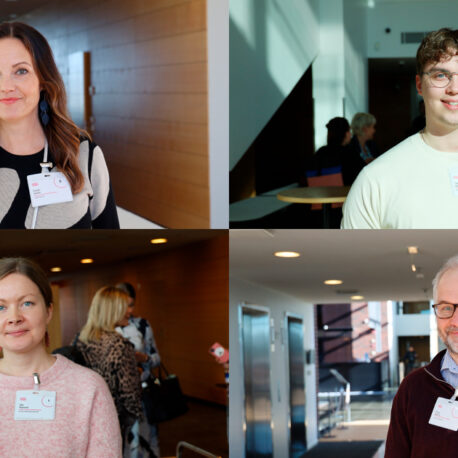
“Based on the survey, the use of generative AI in the financial sector is extensive and firmly established. In the banking sector, 90% of individual employees reported using generative AI applications to support their own work, and in the insurance sector the figure was 95%. The ‘this doesn’t concern us’ mindset has nowadays all but disappeared”, says Senior Specialist Kirsi Yli-Kaitala from the Finnish Institute of Occupational Health.
The changes brought by generative AI impact almost all expert tasks, from analytics, communications, back-office functions and customer interfaces to compliance and HR duties. New use cases are not always covered by existing guidelines, and as the use of generative AI becomes more widespread, issues of interpretation also increase. The survey results highlight a need for updated company policies.
“These new tools regularly present employees with situations where they need more clarity: what data they can utilise, how the outputs should be validated, and who holds responsibility for the final outcome”, Yli-Kaitala says.
The benefits of generative AI have already materialised – companies maintain realistic productivity expectations
Generative AI’s most important benefits for the financial sector are time savings, smoother workflows and improved quality. Based on the survey, expectations related to the productivity benefits of generative AI are realistic and moderately positive. In the banking sector, 66% of respondents estimated that artificial intelligence will have a very positive or fairly positive effect on productivity in the next two to three years. In the insurance sector, the figure was 78%.
“Financial sector respondents did not regard generative AI as a silver bullet that would revolutionise productivity. Instead, their expectations regarding productivity benefits were very down to earth. The respondents did believe that repetitive tasks will disappear and processes will become more efficient over the next two to three years. As the amount of routine and manual work decreases, there’s more time for expert work”, says Finance Finland’s Director of Competence Development and Digitalisation Katja Repo.
Based on the survey results, generative AI is no longer considered a new technology. The next stage is already emerging on the horizon: one of the new applications of AI being piloted in financial sector processes are AI agents.
“At the moment, AI agents are mainly limited to pilot projects and will first be utilised only in internal processes. The role of humans will not become any less important, however, especially when it comes to decisions and responsibilities related to the evaluation of AI outputs”, Repo says.
Wellbeing and workload have become key concerns
According to the survey, experts in the financial sector are concerned about the reliability and quality of the outputs generated by AI.
“Respondents mentioned a high potential for errors as one of the risks associated with generative AI. Caution is always wise, because excessive trust can backfire with anything, generative AI included. Critical appraisal skills and quality assurance are emphasised in all roles. Employees are increasingly expected to evaluate, verify and take responsibility for the outputs of artificial intelligence”, notes Kosti Hyyppä, the finance sector’s collective bargaining advisor for YTN.
Generating high-quality output from generative AI requires new kinds of competence, which makes competence development a critical issue. The majority of survey respondents felt that they need to learn new skills, and a significant proportion felt that they had not received sufficient training.
“Some of the concerns related to generative AI include increased workload, a faster pace of work and the burden of needing to validate all outputs. The survey indicates that the increasing use of generative AI also requires more investment in competence development and employer–employee dialogue”, notes Antti Hakala, director of finance sector at Trade Union Pro.
Hakala emphasises that achieving the best competitive advantage from the use of new technologies requires the full involvement and engagement of employees in the process.
Still have questions?
|Contact our experts




Looking for more?
Other articles on the topic
Not a silver bullet for productivity but an essential everyday tool – the Finnish Institute of Occupational Health examined the use of generative AI in the financial sector

Financial Academy’s Fundamentals of Financial Services now available in English

Responsibility, AI and exercise breaks – The world’s largest virtual work experience event introduced over 9,000 students to work in the financial sector

FIN-FSA surveyed financial sector companies’ use of AI – from crunching data to fighting financial crime