

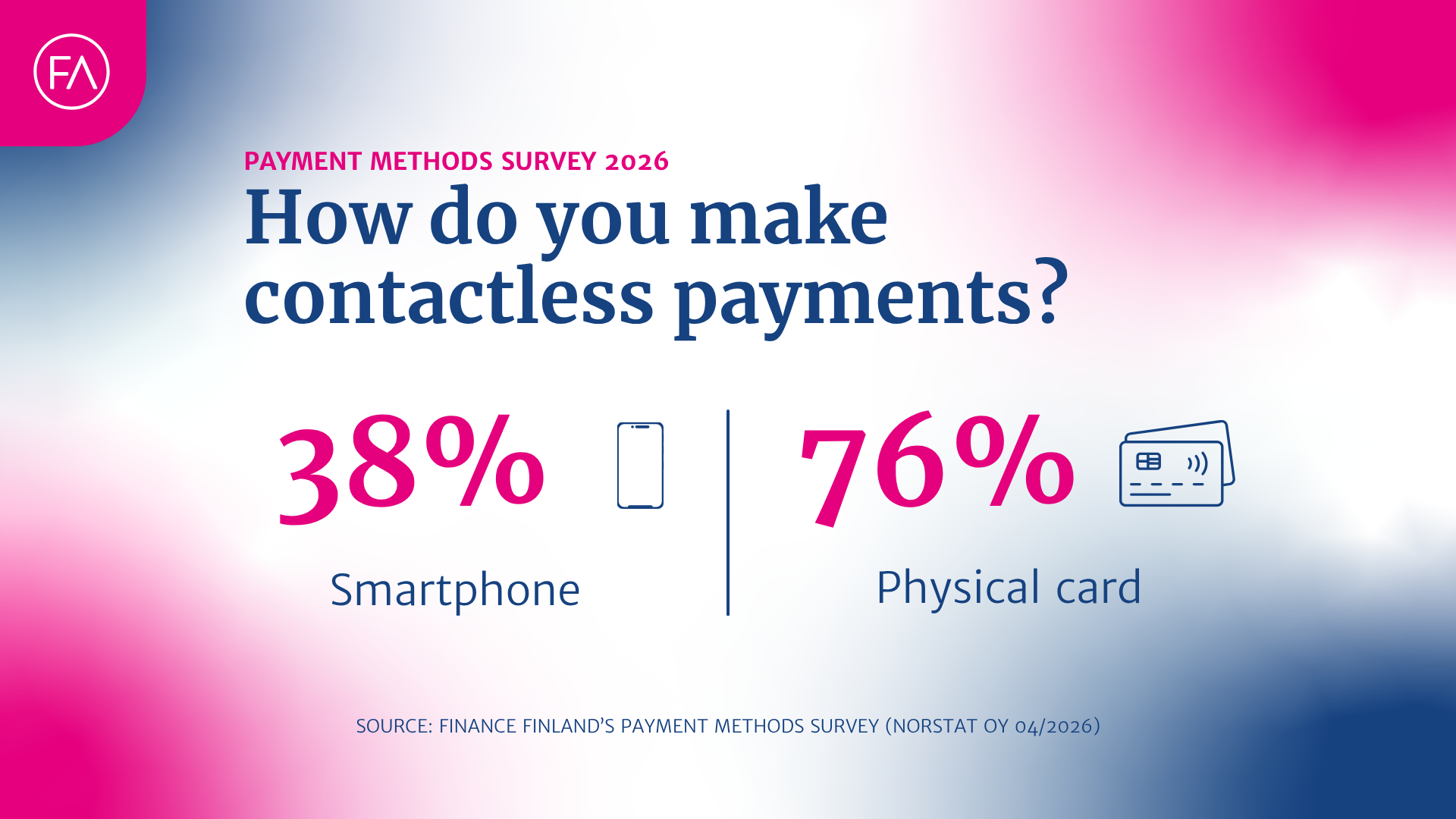
- Finns pay for their purchases using both cards and mobile phones. The younger the consumer, the more likely they are to make contactless payments with a mobile phone.
- Finns are well prepared for payment disruptions: most have more than one payment card and carry cash as an emergency backup. Most households also keep cash on hand for emergencies. The majority of Finns also use the online payment methods MobilePay or Siirto.
The survey was commissioned by Finance Finland and carried out by Norstat between 1 April and 10 April 2026. The sample consisted of 2,563 respondents aged 15 to 79, in addition to 155 children aged 12 to 14.
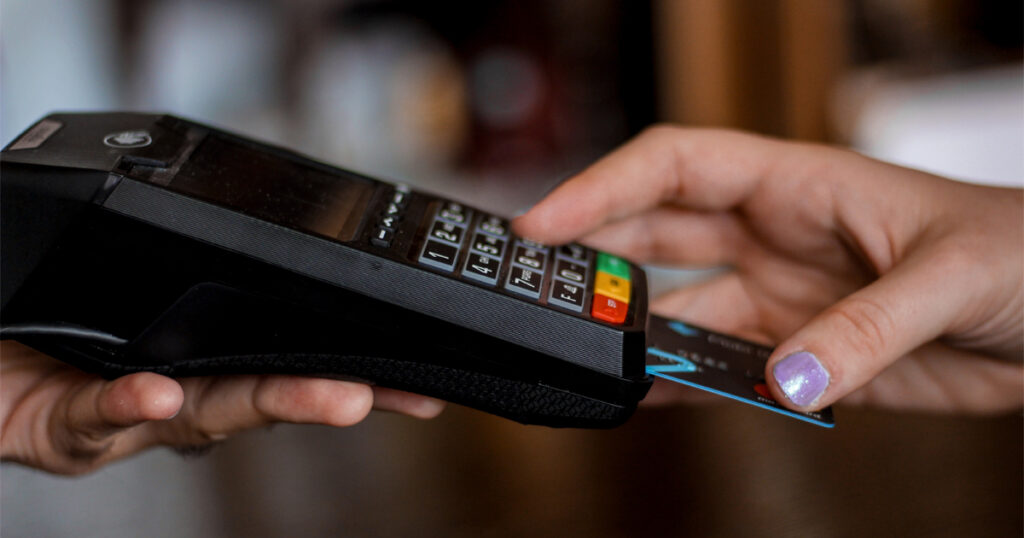
Contactless payment and the use of smartphones for making contactless payments have become a staple among Finns, according to the Payment Methods Survey commissioned by Finance Finland. The latest survey shows that 92% of Finnish consumers use contactless payment at least once a week.
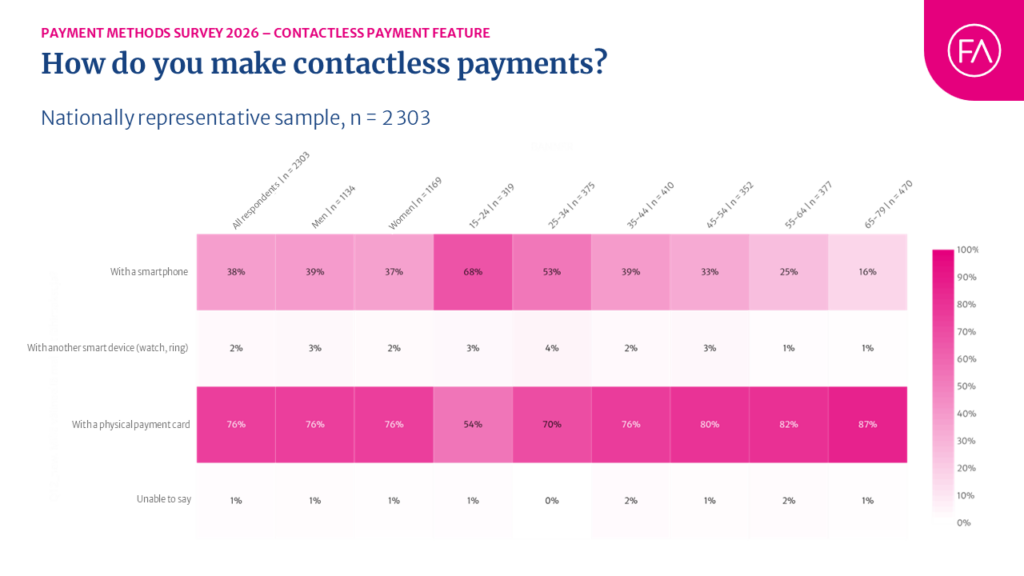
Among contactless payment methods, traditional physical payment cards continue to hold their ground. However, 38% of all respondents reported using a smartphone to make contactless payments. Notably, the younger the respondent, the more likely they are to use a smartphone for contactless payments. The proportion of respondents making contactless payments using other devices, such as smartwatches and smart rings, remains modest for now.
Contactless smartphone payments are very popular among 15–24-year-olds, of whom as many as 68% reported using a smartphone as their contactless payment method. Smartphone-based contactless payments are the next most common among 25–34-year-olds, with 53% using a smartphone to make contactless payments. Smartphone payments are also remarkably common among 35–44-year-olds, with 39% of respondents in this age group using the payment method.
“What you learn young stays with you”
“What you learn young stays with you, as we like to say. The popularity of smartphone payment among younger respondents sends a clear signal about the direction in which payment methods are evolving. Little by little, inserting physical payment cards into payment terminals and entering PIN codes are becoming things of the past”, says Kirsi Klepp, head of card payments infrastructure at Finance Finland.
“It’s noteworthy that among 15–34-year olds, smartphones are more popular than physical cards as a contactless payment method. Other devices, such as smartwatches and smart rings, remain marginal, but they are more popular than in other age groups and receive more mentions than before. The popularity of smartphone-based contactless payment has grown strongly among those under 44. Older Finns also make contactless payments using smartphones, but the older the age group, the slower the shift from card-based payments to smartphones”, says Klepp.
The evolution of payment methods is likely to accelerate further as new services and products become available.
“Consumers are moving towards convenient and secure mobile technology. At the same time, payment acceptance and point-of-sale transactions increasingly utilise mobile solutions alongside traditional POS terminals. In practice, a smartphone can serve as a payment terminal. For example, customers can browse and shop in a physical store through a mobile app, scan their purchases with their phone and complete the payment directly in the application”, says Klepp.
For consumers, mobile payment methods are more secure than physical payment cards. The enhanced security comes from the fact that whenever a user makes a contactless payment using a mobile phone, they are always authenticated. This generally involves biometric authentication, such as facial recognition or fingerprint scanning. The payer can also be authenticated using a PIN code. Biometric methods are more secure than PIN codes because they cannot fall into the wrong hands in the same way as the codes can.
According to Klepp, the latest survey confirms the view that consumers now have more payment options available than ever before.
“Conditions are clearly favourable for the development of payments and competition. This benefits all parties: consumers, who can choose the payment method that is most convenient for them, merchants, who can accept payments through a wide range of methods, and society, where resilience increases when payments are not – neither figuratively nor literally – reliant on a single card”, says Klepp.
Finns prepare against payment disruptions with cash, apps and multiple cards
According to the Payment Methods Survey, every other Finn has more than one payment card. A total of 95% of respondents have at least one payment card.
Among mobile payment services, MobilePay is used by 63% of all respondents, both MobilePay and Siirto by 12%, and Siirto alone by 2%. About one in four respondents used neither service.
Finns continue to regard cash as the ultimate safeguard in the event of emergencies. The most common reason for withdrawing cash is daily spending (40%). The second most important reason is preparedness for rainy days (33%). Cash is also frequently withdrawn for travel purposes (17%). It is no longer considered primarily a means of payment, but rather a backup option.
A total of 76% of respondents said they usually carry cash on their person. More than half reported carrying no more than €50 in cash. One in five respondents carried between €50 and €100 in cash. Respondents also considered it important to keep physical cash at home for emergencies: as many as 88% of respondents reported they maintained a stash of cash at home.
“Finns are exceptionally well prepared for disruptions affecting payments. This is evident in their use of backup cash, the widespread adoption of mobile payment methods and the fact that many people have more than one payment card. Being prepared in such diverse ways is a sensible approach. Finns have done their part and prepared well”, Kirsi Klepp says.
Share







Contact our experts
-
Kirsi Klepp
Head of Card Payments Infrastructure
Payment instrument infrastructure: card-based payment, cash, stablecoins, technical and security standards and descriptions related to payment instruments